Add workflow intelligence wherever your program is in the lifecycle.
TraceOps AI helps government contractors support bids, awarded programs, delivery workstreams, audits, production releases, and maintenance operations with a clearer shared record that lets program owners and project leaders turn client asks into aligned work for their teams.
Start with the program phase you are in. Expand when the workflow is ready.
Use ProposalTrace before an RFP submission, AwardTrace after a win, Development Matrix during delivery, AuditTrace before audits, ReleaseGuard before production, and MaintenanceTrace after release.
Adopt TraceOps AI at the phase your program is already in: pursuing an RFP, managing an award, delivering work, preparing for audit, releasing to production, or maintaining a fielded product.
Give competent program owners, project managers, and executive leaders a common operating record for requirements, obligations, evidence, blockers, approvals, and decisions.
Turn each phase into aligned work for capture, compliance, engineering, delivery, audit, release, and maintenance teams so the intermediary govcon can translate what the end client asked for into clear internal execution.
Support commercial, non-controlled program environments with disciplined workflow language, human review, and traceable handoffs instead of ad hoc document churn. TraceOps Commercial is not authorized for CUI, classified, ITAR, or other restricted data.
Built for the Defense Industrial Base
Workflow automation and lifecycle management for the program managers who win defense work — not just the engineers who deliver it.
TraceOps AI is built for non-technical product and program managers at federal defense contractors, GovTech firms, and the broader Defense Industrial Base. It helps you find and apply for DoD bids, translate dense compliance language into plain next steps, stand up programs and projects, manage them across the full lifecycle, and hand structured deliverables to the technical engineers who execute, test, and deploy.
Find and apply for DoD bids
Guided bid intake and discovery surfaces relevant solicitations and walks a non-technical PM through what each opportunity actually requires before the clock runs out.
Translate compliance into plain steps
Dense FAR/DFARS-style requirements, CDRLs, and evaluation criteria are turned into clear, owner-assigned tasks a program manager can act on without a compliance specialist on call.
Stand up and run the program
Set up programs and projects, assign owners, and manage the work across every lifecycle phase from one shared, traceable record instead of scattered spreadsheets and email threads.
Hand off cleanly to engineering
Produce structured handoff packages so technical engineers can execute, test, and deploy against the exact obligations the contract defines — no re-interpretation, no lost context.
The defense market opportunity
The dollars are enormous, and the field of competitors is shrinking.
Manual, bureaucratic defense-contracting work — hunting for bids, decoding compliance, allocating teams, and packaging deliverables by hand — burns the time, money, and people that smaller and non-traditional contractors do not have to spare. TraceOps automates that workflow so a leaner team can compete for federal defense contracts on a more level field.
$423.3B
Total dollars the U.S. Department of Defense obligated for contracts, products, and services in fiscal year 2024 — the addressable spend non-traditional contractors are competing to reach.
A DoD report on competition in the Defense Industrial Base found the number of small businesses in the DIB shrank by more than 40% over the past decade, citing consolidation and reduced competition as a national-security concern.
Figures are quoted from the publicly available sources linked above and describe the market, not a TraceOps outcome or guarantee. The FY2024 obligation figure is also published in the OLDCC abridged report at https://oldcc.gov/sites/default/files/2025-11/oldcc_dsbs_fy2024_abridged_nov25.pdf.
Current state vs. future state
From manual bureaucracy to a guided, structured workflow.
The work that consumes a defense program manager today is mostly manual and bureaucratic. TraceOps automates the same tasks into a guided workflow with structured handoffs.
Bid discovery
Today, by hand
Manually scan SAM.gov and forwarded emails, guess at fit, and miss opportunities buried in attachments.
With TraceOps
Guided bid intake surfaces relevant DoD solicitations and flags what each one requires before you commit time.
Compliance translation
Today, by hand
Read dense FAR/DFARS clauses and CDRLs by hand and hope nothing compliance-critical was missed.
With TraceOps
Requirements are extracted and translated into plain, owner-assigned tasks with the source clause attached.
Team allocation
Today, by hand
Stand up the program in spreadsheets and chase owners across email, chat, and status meetings.
With TraceOps
Set up the program once; owners, acceptance criteria, and dependencies live in one shared, traceable record.
Deployment handoff
Today, by hand
Hand engineers a pile of documents and re-explain intent until something close enough gets built.
With TraceOps
Produce a structured handoff package so engineers execute, test, and deploy against the exact obligations.
Bid Planning
ProposalTrace
Add TraceOps AI before an RFP submission to extract requirements, map traceability, and catch compliance gaps while the bid is still shapeable.
Post-Award Clarity
AwardTrace
Use the award package to turn contract files, mods, CLINs, and deltas into operational obligations and handoff packs.
Delivery Execution
Development Matrix
Convert awarded obligations into owner-assigned workstreams, acceptance criteria, evidence needs, dependencies, and release preconditions.
Evidence Workspace
AuditTrace
Prepare for upcoming audits by keeping evidence, control alignment, and readiness history in one reviewable place.
Production Readiness
ReleaseGuard
Gate production releases with blockers, approvals, evidence, and final decision records before execution moves.
Post-Release Control
MaintenanceTrace
Track incidents, patches, change requests, SLA issues, corrective actions, and contract impact after the product is in maintenance.
ProposalTrace, in action
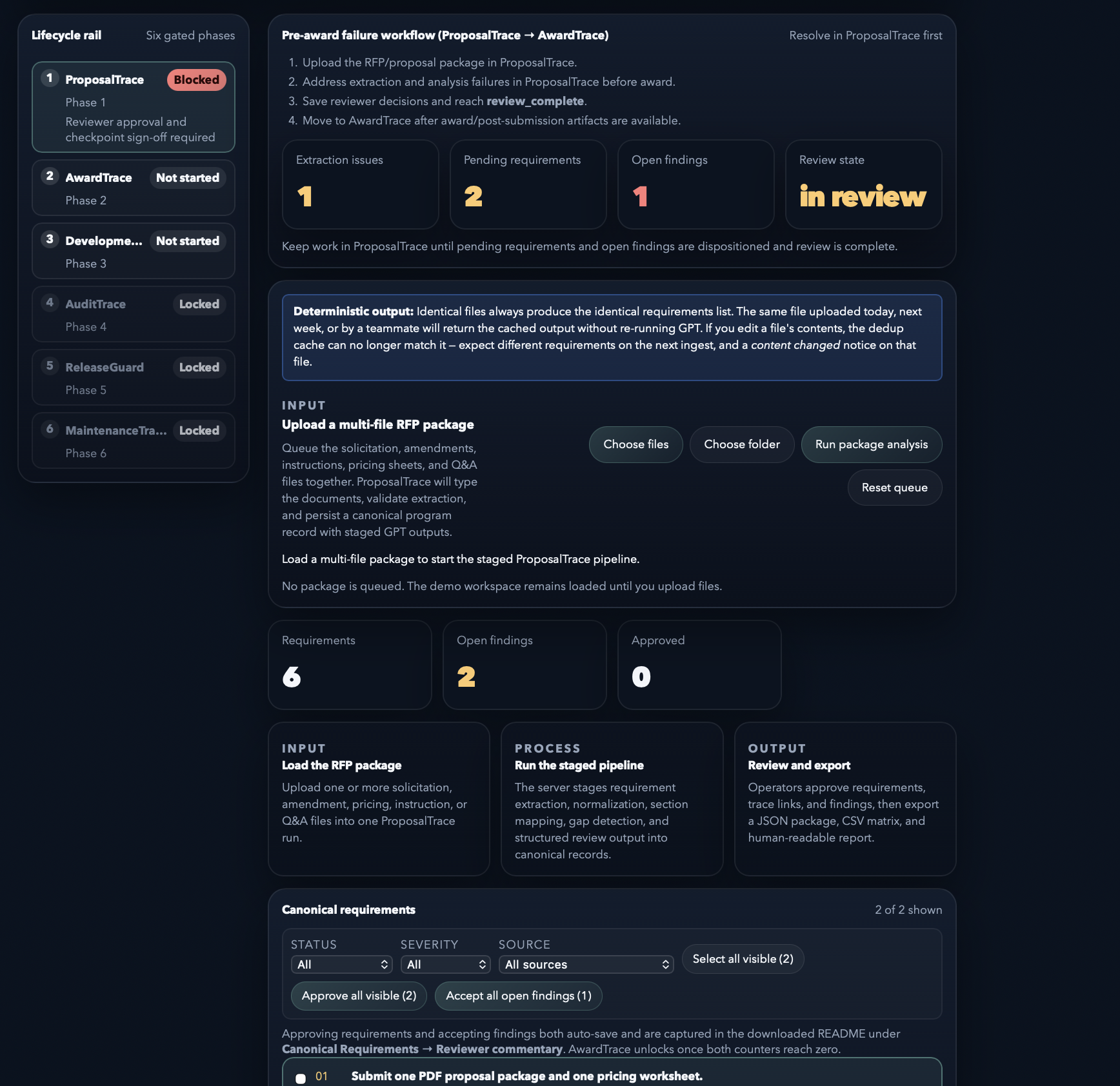
A real screenshot from a live TraceOps workbench. The lifecycle rail on the left shows the six gated phases in real product UI. The right side shows the active extraction and review state for an ingested RFP package, with deterministic-output caching above the upload affordance and a canonical-requirements grid below.
Not running govcon work?
Commercial teams use TraceOps too.
The same six-phase lifecycle — proposal, award, development, audit, release, maintenance — applies cleanly to commercial enterprise workflows like customer RFP responses, internal audits, release governance, and post-launch operations. Same packages, same platform, same data restrictions.
The same product-lifecycle discipline PMI defines — for software, commercial, and government products.
TraceOps is deeply aligned with the product lifecycle and the core project-management concepts codified by the Project Management Institute (PMI). The underlying body of knowledge does not change with the deliverable: whether the product is software, a commercial offering, or a government program, the same lifecycle discipline applies. TraceOps turns that discipline into a shared, traceable operating record across all six phases.
One lifecycle, every product type
Software products, commercial products, and government deliverables all move through the same arc: define, plan, execute, control, release, and sustain. TraceOps applies that single discipline to all of them instead of a separate method per program.
Mapped to PMI process disciplines
The six phases line up with the initiating, planning, executing, monitoring-and-controlling, and closing process disciplines the Project Management Institute (PMI) codifies — turning recognized project-management practice into everyday workflow.
Full lifecycle, not a point tool
From proposal through maintenance, TraceOps follows the product across its entire lifecycle rather than stopping at a single phase, so requirements, evidence, and decisions carry forward end to end.
Discipline that transfers
Because the lifecycle is product-agnostic, the same operating rhythm moves from one contract, product, or program to the next — teams reuse one proven method instead of re-learning a new one for each engagement.
Project Management Institute, PMI, and PMBOK are trademarks of the Project Management Institute, Inc. References describe methodological alignment only and do not imply affiliation, sponsorship, or endorsement.
Why ProposalTrace First
Lead with the urgent program problem, then expand into the suite.
ProposalTrace is often the best first deployment for teams with an active RFP, but the same platform can support programs that have already won, teams in delivery, upcoming audits, production release gates, and products already in maintenance.
The operating goal is simple: help teams deliver closer to the client specification, create better-aligned work across every phase, and keep maintenance structure visible before post-release work begins.
Small, mid-sized, and large government contractors with one critical program or many parallel programs
Teams preparing bids, managing active awards, delivering products, preparing audits, approving releases, or operating maintenance workflows
Product owners, program managers, capture leads, delivery leads, compliance teams, and VPs overseeing expensive mission-critical programs
Organizations coordinating commercial, non-controlled program work across Word, SharePoint, email, spreadsheets, and disconnected review meetings
DoD and civilian services contractors carrying national security, public-sector, or citizen-impacting responsibilities
Trust Posture
Controlled workflows over magic outputs.
Human review remains in the loop at every critical decision point.
Outputs are organized for traceability instead of positioned as a generic chatbot.
TraceOps Commercial uses third-party AI providers for document analysis and is not authorized for CUI, classified, ITAR, or restricted government data. Classified or CUI-authorized deployments would require a separate offering and are not included in TraceOps Commercial.
Security messaging stays within safe claim boundaries: readiness workflows, not certification claims.
Specification alignment
Help program leaders translate end-client requirements and obligations into clearer team workstreams so delivered products stay closer to the exact client specification.
Less delivery drift
Reduce the chance of over-delivery, under-delivery, missed evidence, or late blocker discovery by keeping obligations, acceptance criteria, and maintenance needs connected.
Faster team rhythm
Give recurring proposal, development, deployment, and maintenance roles a more efficient operating loop for creating, assigning, and completing aligned work.
Built for your program
Configured to your contract, your reviewers, your cadence.
TraceOps is not a generic chatbot bolted onto a template. The platform shapes itself around the specific contract vocabulary, review cadence, and program portfolio you already run, so the workflow looks like how your team actually delivers — not how a vendor wishes you would.
Tuned to your contract vocabulary
Bring your own RFP, award package, and SOW templates. TraceOps adapts requirement extraction, traceability labels, and reviewer prompts to your contract structure instead of forcing a generic schema.
Adapts to your review cadence
Map your reviewer roles, gate criteria, and approval steps into each phase. Whether you run weekly stand-ups or stage-gate boards, the workflow respects how your program already operates.
Scales with your program portfolio
Run one critical pursuit or dozens of parallel programs on the same platform. Per-program workspaces, per-tenant isolation, and per-phase entitlements let you adopt at the depth that matches budget and risk.
Exports into your existing systems
Every phase produces a clean handoff package (JSON, CSV, Markdown, PDF) so the output drops into SharePoint, Jira, ServiceNow, or whatever record-of-truth your delivery team already uses.
Why TraceOps
Infrastructure your auditors, your customers, and your board will recognize.
Program work is too expensive and too visible to run on spreadsheets. TraceOps is built for the operating posture that mission-critical contracts demand — audit-grade by default, tenant-isolated by default, scalable from a single critical pursuit to a portfolio of parallel programs.
Audit-grade by design
Append-only, hash-chained audit log on every phase decision. Every reviewer action, every export, every gate transition is reconstructible — the standard your auditors, your customers, and your board expect.
Mission-critical-ready architecture
Built on Azure Container Apps + Postgres with point-in-time recovery, geo-redundant backups, and tenant-isolated storage. The same engineering posture that government contractors use to defend programs under real audit pressure.
Rapid time to value
First-day workflow on the phase your program needs most. Pilot on a single active RFP or release and measure tangible reviewer-hours saved within the first cycle — no quarter-long integration project required.
Capital-efficient operating model
One platform replaces ad-hoc spreadsheets, scattered SharePoint folders, and disconnected review meetings across six phases of program work. Per-phase add-ons let you expand spend only when the phase is delivering.
The customer journey across the lifecycle
What changes when TraceOps is in your operating model.
The same lifecycle transformation applies whether you are a government contractor on unclassified work, a commercial enterprise team running customer engagements, or a program team that will move classified-side work into a separate authorized deployment later. The platform page lays out the five-step arc: what is in the product, what you get on day one, how your day to day changes, what results you will see in the first quarter, and the transformation when the full platform is in.
Each package maps to a practical program need: diagnose the current bottleneck, improve proposal execution, connect award to delivery, or standardize the full lifecycle for important work.
ProposalTrace
$2,000/mo
Requirement extraction, traceability support, and reviewer workflow
Submission-risk visibility with exports for internal delivery teams
Best for teams submitting bids on active RFPs and needing a cleaner compliance record
TraceOps Core
$5,000/mo
ProposalTrace, AwardTrace, and Development Matrix support
Award, modification, obligation, and development-workstream clarity
Best for teams moving from win to specification-aligned delivery without losing contract context
TraceOps Platform
$10,000/mo
All six phases: proposal, award, development, audit, release, and maintenance
Evidence mapping, release control, maintenance impact, and executive visibility
Best for teams standardizing timely delivery, maintenance structure, and commercial unclassified lifecycle oversight on one platform
Take The Next Step
Start where your program needs help now.
Contact us about the phase that matters most: bid, award, development, audit, release, or maintenance. If your account is already live, sign in and continue the workflow.